


Chinese Dining Etiquette
Easy chinese dining etiquette for those who want to be educated in Chinese culture.
See also Chinese table manners
The Chinese enjoys socializing during meals. Dinners are the highlight of a chinese family. Every Chinese cultural celebration is centered around food.
Chinese Dining Etiquette
How To Dine - A "Family Affair" Dining Style
This is how it happens.
You'll probably be seated at a round large table with any where from 8 - 12 seats. The variety of dishes are shared from communal plates placed in the center of the time. Everyone takes a small portion of the dishes to eat with rice.
The 'eating ritual' is festive for asians and they tend to eat in larger groups to be able to enjoy a greater variety of food. This is because the number of 'dishes' ordered depends on the number gathered around for food.
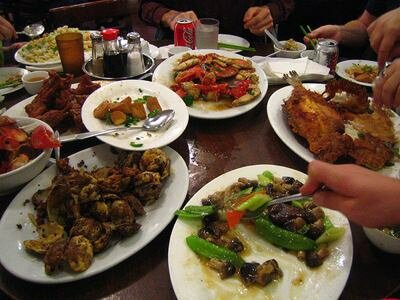
Don't be bewildered by the dish presentations if they look like they come from Mars. I've been dining at Chinese restaurants all my life and I still get surprised.
At dinner, you'll be first served a bowl of white rice with a pair of chopsticks and a chinese soup spoon.
However, you are not expected to use them if you are not chinese. It wouldn't be considered bad Chinese manners. You may request for a fork and spoon.
You will also be served a cup of chinese tea to go with your meal. You may also request for water or a soft drink if you like.
Napkins may be placed on your lap though it is really your choice.
A chinese dinner is very festive and may be noisy.
It is not like in other restaurants where the quieter it is, the more refined and superb the food is expected to be.
In large famous expensive Chinese restaurants, you'll still find the festive (read noisy) table full of laughter, sound, chatter by the chinese people. They let go and let loose sometimes. (Which explains very noisy Chinese wedding dinners and more so with alcohol).
Chinese Dining Etiquette
How to Order and Behave in a Chinese Restaurant
Ordering
Someone will order all the dishes or a collective decision will be made It usually happens this way. Either an authoritative figurehead will decide on the order or discuss the choices with a handful of people (round the large Chinese table).
There may be a restaurant's speciality which is probably the reason why the restaurant was chosen. For instance, the Four Seasons Chinese restaurant in London is famous for their duck dish.
The Chinese, whether they are there for leisure or business, will make a stop to try that restaurant. Though, culturally, it is also good Chinese dining etiquette to be open about trying new dishes, as the Chinese are very adventurous with their food.
Most of these 'famous dishes' are spread by word-of-mouth, as talking about food is a favourite topic in Chinese culture.
A large number of dishes are usually ordered, from 6 - 10 dishes at least.
Even though you may be in an English speaking country, it is acceptable to order in Mandarin or Cantonese in a chinese restaurant.
Serving
Food dishes are placed in the center of the round table. They are communal which means everyone helps themselves to the plate.
They will be served according to when they are cooked, so it comes quickly one after the other. It is acceptable to finish the dishes on the first few plates and have them removed so that there will be more room for other dishes.
It is common practice for the waiter to combine two half-finished dishes onto one plate to make room for new dishes at the table. This is not rude, but viewed as a practical method of saving place.
Dining
You are not obligated to take any dish if you do not like it. It's free and easy for all. Obviously, it will be inconsiderate to eat too much of everything. There is a common understanding of sharing with everyone.
If there is say, one prawn left on the dish plate, the common courtesy is to ask around if anyone wants it? Usually you will receive a hospitable response to 'go ahead and have the last piece.'
Chinese Dining Etiquette
"Double Dipping" Is Accepted
Due to the nature of dining - everyone sharing dishes in the center of the table, a certain "double dipping" is accepted.

It's generally more accepted to reach, cross, pass than in european dining etiquette. However I still believe in utmost consideration such as politely asking.
As the dishes are served on "communal plates" to be shared, it is not rude to "double dip". That means, you are free to use your chopsticks to grab food unto your bowl or plate. And again and again when you want more of it, you help yourself to it.
If a serving spoon is provided, it is good chinese manners to use the serving spoon. While you 'dip' your chopsticks to grab some vegetables or meat, you'll be considerate not to 'stir' your chopsticks into the food, or whatever you grab does not touch the surrounding meat. The least you could do is to minimize contact of your chopsticks with the other food as much as possible.
This is not as strict as european or american table manners in terms of double dipping but its general consideration.
It is also a courteous gesture for the male person beside you who has longer arms to put food on your service plate. It is generally not necessary for him to ask if you would like it. He would put a couple of dishes on your service plate so that you do not have to 'reach'. It is good manners for the guy to put food on your plate first before his.
It also doesn't matter if he has already used his chopsticks. Not in chinese dining etiquette anyway. It's common for friends to do so for each other as well.
Chinese Dining Etiquette
Standing or Reaching for your Food at the Table
It is not rude to stand up and reach for a dish. As everything is placed in the middle of a round table which may not have a Lazy Susan.
However, a more refined alternative is to ask politely for it to be passed to you. You may also hold out your service plate for someone sitting near that dish to scoop some for you.
In restaurants where you have the convenience of a lazy Susan, it is general consideration to wait until there is moment where no one is taking food from the common dish plates to turn it around.
Chinese Dining Etiquette
What NOT to do in Chinese Dining
Never stick your chopsticks upright in your rice because that reminds asians of the 'Praying to the Dead' death ritual where joss sticks are used that look similar to chopsticks.
Also, when seated, never start reaching or eating food served on dishes until the host starts or until everybody is ready.
Before you eat, generally, the children or the youngest of the table usually show their respect by 'asking their elders to eat'. They may say, "Grandfather, grandmother, please eat (start)," and followed by, "Mom, Dad, please eat". Then the elders will smile and indicate to everyone by slightly raising his chopsticks, "Everybody, eat!" And that's when the meal starts. It is similar when the French say, "Bon Appetit!" or when the Japanese says, "Itadakimasu!"
Chinese Dining Etiquette
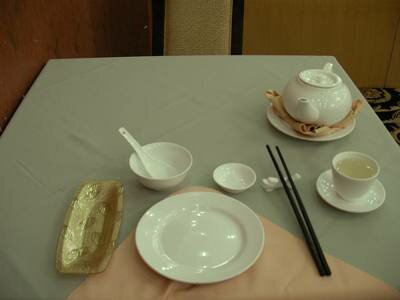
Visual Example Chinese Table Setting
This will be your individual Chinese table setting at a Chinese restaurant.
Chinese Dining Etiquette
When It Comes To Who Picks Up The Tab
Can Be Applied As Chinese Business Etiquette
In the most genteel chinese society, there is no such thing as "going Dutch". If you are invited to dinner, your dinner will usually be paid for by the host.
Chinese dinners are usually large in numbers, and still, the tab is usually picked up by one person, usually the host or the elder.
Sometimes there is a "fighting to pay the bill" going on when the bill comes. This refers to friendly 'bickering' (in the most positive sense) over who pays the bill. This is considered VERY GOOD Chinese dining etiquette. Your manners are just considered so-so, plain if you don't at least attempt to try to pay for the other person.Because to them, it is a show of appreciation and gratitude. And that you do not take things for granter.
Usually the host will win the 'fight', but as a guest, it's good to put up a struggle a little, even if it is for show. However, if you do 'win', you should graciously pay the bill, though if you relay this situation to the Chinese, they would think the host is rude!
There are some exceptions. This will not apply if the person you are dining with is at least one to two generation older than you (10-20 years). It is understood that the person more senior usually picks up the tab. For example, if you are dining with your parents. But of course, if you are the host, picking up the tab is good chinese dining etiquette.
Though, there is such a thing as 'social debt' in Chinese culture. If your host is constantly inviting you for dinner and picking up the tab. YOU MUST repay the favour but asking them out to dinner and PICKING up the tab. If you don't, your invitations by the host will cease.
This is especially important when it comes to business functions and business entertaining especially if you do business or network with the Chinese (or anyone from Chinese culture). If you are seeing a client, you'll have to pick up the tab.
You might be interested in:
- Etiquette Proper Table Setting How To Set A Table Properly
- Table Setting Etiquette Three course dinners, family dinners and know your wine glasses
- Elegant Table Settings
- French Table Manners

Go back to Elegance at Work.
Return from Chinese Dining Etiquette to Elegant Woman Home
chinese table manners, table manners in china, dinner table etiquette, basic table manners
