Chinese Manners - Etiquette
Wondering about Chinese manners? Chinese etiquette is different which may come across as overly practical and hospitable. Read more about Chinese dining etiquette as well Chinese business etiquette so you'll be well equipped (and not puzzled) for your next experience!
How to Greet in Chinese Manners
Generally, people say hello and ask you if you have eaten.
"Hi how are you?", followed by, "Have you eaten?" (or "Have you had your lunch?")
Food seems to be very important to a Chinese person or a person of Chinese culture. If you haven't eaten, they would make sure that you are fed first.
Greeting Elders is a Sign of Respect in Chinese Manners
There is also a great respect towards the elders, and that does not mean the elderly, but it means someone who is more senior to you in terms of age.
A little child would respectfully address you, as "big sister" if you are fairly young, maybe in your teens to your twenties and possibly unmarried, or "aunt" if you are married or older. If you have grandchildren of your own, the little child may address you as "grand mother".
These "address-es" are spoken in Mandarin (or a dialect) where they just 'call' your title as a sign of respect. It is an acknowledgement of your presence.
Do not greet your elders by name
It is extremely disrespectful not to do so and call by name. Children never call their fathers by their first name, "John" but will always use 'Daddy' or 'papa'.
In the more Anglo-Chinese culture (where people there is a strong presence of English and respective influence), people sometimes attach their names to their 'title'.
You may introduce yourself as Aunty Jenny to a child or a teenager and they should only address use as that.
You might be middle-aged but you'll still have to address an elderly lady as "grandmother". Once a lady reaches a senior and mature age, she'll prefer to be addressed as "grandmother".
If you are in a situation where you are not sure how to address, you may ask (this is not considered rude). Most Chinese manners apply only if you are Chinese, but if you are not your efforts will be seen as a compliment.
Please note that the above situation are for informal situations only. They are not to be used in a business situation.
Chinese Manners - Chinese Dining Etiquette
Most Chinese socialize during meals. Dinners are the highlight of a Chinese family. Every celebration is centered around food.
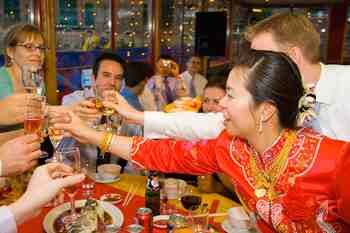
Food are shared from communal plates set in the middle of a big round table. You'll either use serving spoons or your chopsticks, whichever is provided to pick the foods to be eaten when your bowl of rice.
Before you eat, generally, the children or the youngest of the table usually show their respect by 'asking their elders to eat'. They may say, "Grandfather, grandmother, please eat (start)," and followed by, "Mom, Dad, please eat". Then the elders will smile and indicate to everyone by slightly raising his chopsticks, "Everybody, eat!" And that's when the meal starts.
A Chinese dinner is very festive. It is not like in other restaurants where the quieter it is, the more refined and superb the food is expected to be. In large famous expensive world renown restaurants, you'll still find the festive (read noisy) table full of laughter, sound, chatter by the Chinese people. They let go and let loose sometimes. (Which explains very noisy Chinese wedding dinners and more so if there is alcohol).
Important Chinese Manners - "Snatching" to Pick Up the Tab
Can Be Applied As Chinese Business Etiquette
In the most genteel Chinese society, there is no such thing as "going Dutch". If you are invited to dinner, your dinner will usually be paid for by the host.
I really like that about the Chinese manners and the Chinese culture. They show hospitality to the max and I can say they are the most hospitable people in the world.
Just the same that if we are invited to dinner by our parents, no matter how old we are, the dinner will be paid by our parents.
Chinese dinners are usually large in numbers, and still, the tab is usually picked up by one person.
Sometimes there is a "fighting to pay the bill" going on when the bill comes. This refers to friendly 'bickering' or 'arguing' (in the most positive sense) over who pays the bill. This is considered VERY GOOD MANNERS. Most Chinese people know that if there is no fighting for the bill, your manners are just considered so-so, plain.

My oriental themed party where I was the host.
Usually the host will win the 'fight', but as a guest, it's good to put up a struggle a little, even if it is for show. I know some of you might think it's silly but that is the way it is!
Generally this will not apply if the person you are dining with is at least one to two generation older than you (10-20 years). It is understood that the person more senior usually picks up the tab. But of course, if you are the host, generally picking up the tab shows good Chinese manners.
Though, there is such a thing as 'social debt' even in Chinese culture. If your host is constantly inviting you for dinner and picking up the tab. YOU MUST repay the favour but asking them out to dinner and PICKING up the tab. If you don't, your invitations by the host will cease.
This is especially important when it comes to business functions and business entertaining especially if you do business or network with the Chinese (or anyone from Chinese culture). If you are seeing a client, you'll have to pick up the tab.
The Issue of Red Packets in Chinese Manners
Red packets are the literal translation of the Chinese Words (Mandarin).
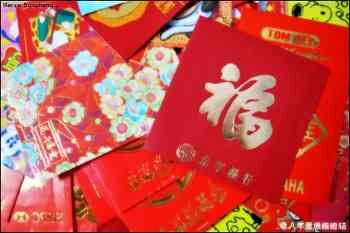
These are little envelopes which are "money packets", meaning they are used to put money inside only.
The reason why it is red is because it is to signify good luck, as red in Chinese culture is an auspicious color.
In other cultures, giving of money is considered distasteful, but not in Chinese culture.
It is good manners to give red packets to your loved ones, but usually only if you have married. If you are not, you are not expected to. Though if you are middle age and above and single, you may dish out red packets.
When do you give red packets?
These red packets are usually given at festive or happy events, such as weddings (usually preferred and common over a wedding gift), birthdays(instead of a gift), Chinese new year where the married will give to children and single family members or friends when they visit each other.
Just think of it as the Chinese people are hard core on being practical.
Red packets are to be given "down" your 'rank'. That means it is not common that red packets to be given to peers, unless at weddings. So grandparents give their children and grandchildren, and aunts and uncles give their nieces and nephews or children of their friends, so on and so forth.
You should never ask for a red packet. The proper Chinese manners is to be given a red packet. Usually at Chinese New Year, children will take oranges to their elders and receive red packets in return. This signifies a 'wishing of good luck' or 'blessing'.
Red Packets as Wedding Presents in Chinese Manners
At weddings, it is considered good manners to give a red packet of an appropriate amount (if you are not sure, you may ask fellow guests of Chinese culture). This amount varies from country to country, place to place. It is not considered good manners to turn up with a wedding gift at a Chinese wedding.
Though it will not be considered rude, but the preferred gift is the red packet for good luck and practical reasons (as Chinese wedding dinners are often 10 course meals with fancy preparation and can cost 3 times the cost of a non-traditional Chinese wedding).
At the Wedding, there will be a box with a small slit at the guest table, where you'll place your red packet in. Obviously, it is better to write your name and a short congratulatory message at the back of your packet. Though it is not mandatory.
Many uninformed find themselves embarrassed when they find out that they are the only ones at the wedding with a wedding present and no allocated place to put it. I've friends till this day, who married more than twenty years ago, speak unhappily about their overseas guests bringing them 'paintings' and other items. I'll just say that they are not aware of other cultures too.
The right manners is to do as they do if you are attending a wedding of their culture. It is rude to impose our manners and culture on them. When in Rome, do as the Romans do.
That being said, there are so many Anglo-Chinese cultures and mixed Chinese cultures. It is best to ask the host or a closely related guest, and this will not be considered rude but very kind and considerate of you to find out so.
You might also be interested in:
Chinese Table Manners
Proper Business Card Etiquette
International Business Etiquette
Business Meal Etiquette

Go back to Elegance at Work.
Return from Chinese Manners - Etiquette to Elegant Woman Home
Chinese manners, Chinese dining etiquette, Chinese etiquette, Chinese business etiquette